You would speak to you’re parents how you would to your boyfriend. You wouldn’t speak to your teacher how you would your friend. So why when chatting online, do these rules become faded? When talking online participants receive the benefits of a faceless conversation, meaning you cannot see the face of whom you are talking too.

This means that you can use online language features like grammatical inaccuracies and acronyms as you’re recipient cannot see you speak and vice verse, eliminating the potential awkwardness of a conversation.
Another feature of online language and social interaction is the use of emjoi’s and emoticons. They have become that popular within language now that they can determine a lot of things from a sentence. For example it can determine a mood.
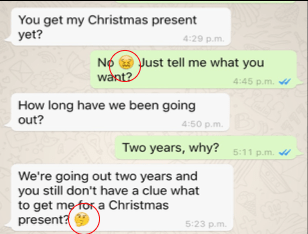
An example of this would be the text above. It is a conversation between a couple and what they are going to buy each other for Christmas. With the circled emoji at the top, the sentence appears innocent and almost a bit playful. However, if you were to remove the emoji, the message would appear less innocent and actually, pretty sinister. This is the power that an emoji can hold in a conversation.
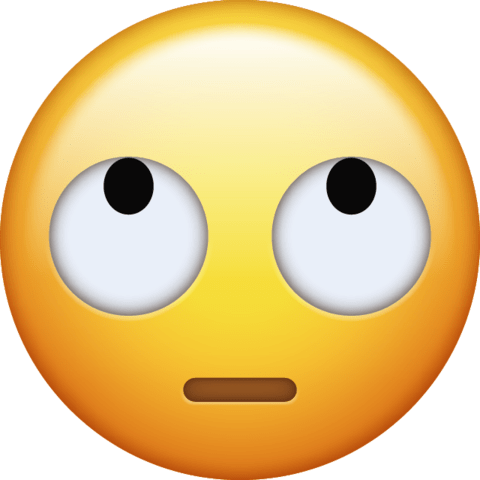
However, one step further than an emoji is a GIF. A GIF is an animated picture; effectively an emoji that moves. This is therefore even more useful to portray an emotion within a conversation and, a lot of the time, can be used alone in a conversation that will hold communication and can be understood.
A GIF can also portray emotions a lot more accurately than an emoji can. This is due to there being a lot more GIFS available as people can make their own. The movement can also help portray motion as it allows the recipient to be able to see more of the emotion.

Overall, the different between speaking online and in person is staggering, its almost a different language. In fact, it is. Netspeak is a term developed by David Crystall and it describes how we talk online. An extreme example of this is below:
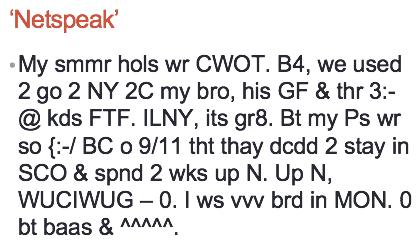
However, a lot of the time its just little things like changing ‘you’ to ‘u’ or ‘because’ to ‘bus’. It makes it quicker and easier for people to type which in a world that revolves around time and ever shrinking keyboards, is very important.
 Language and New Media